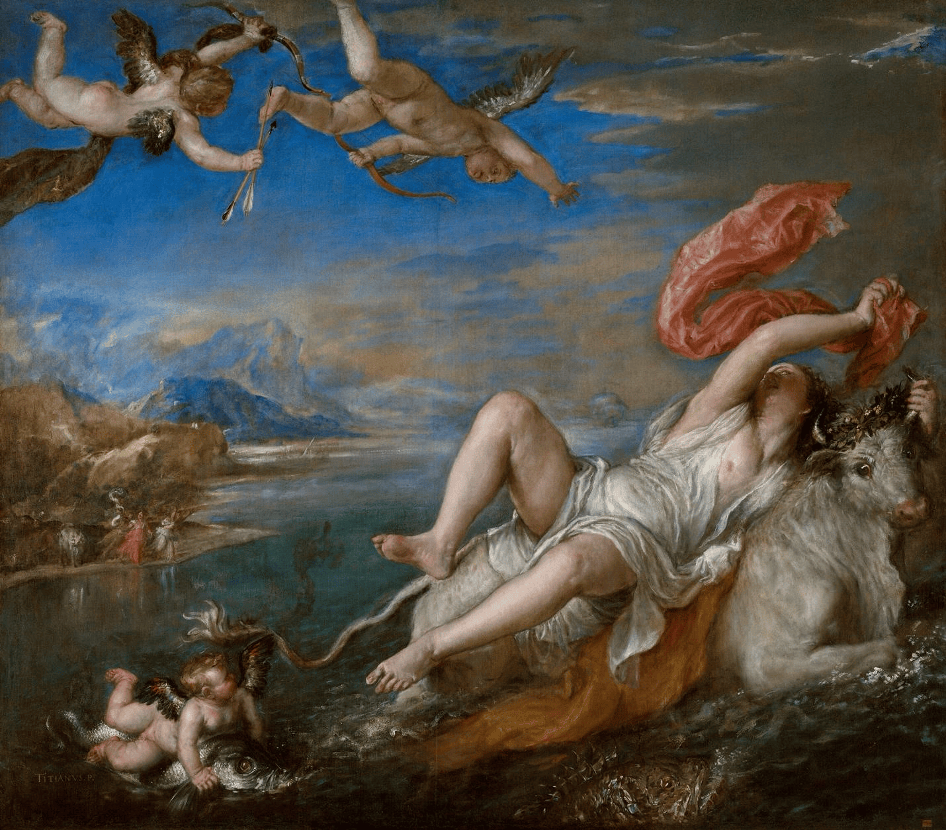
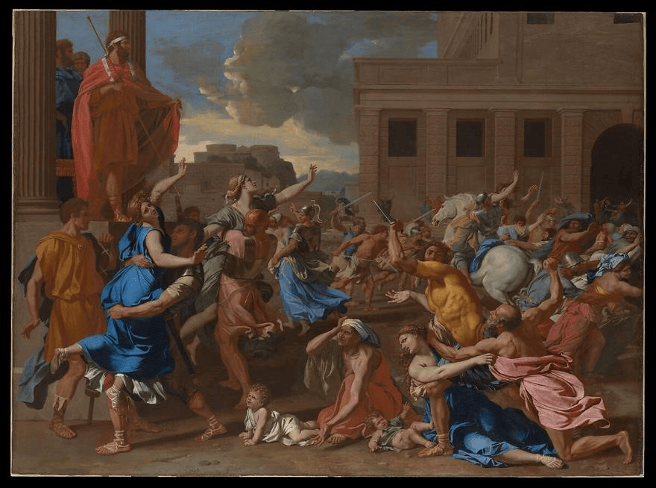
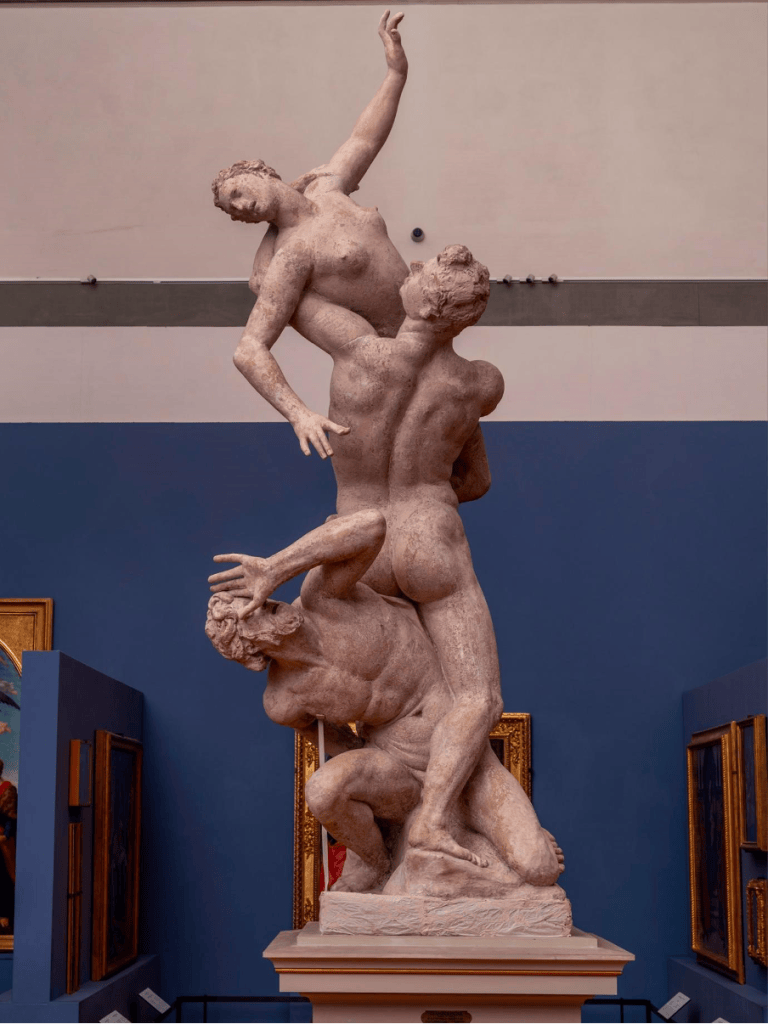
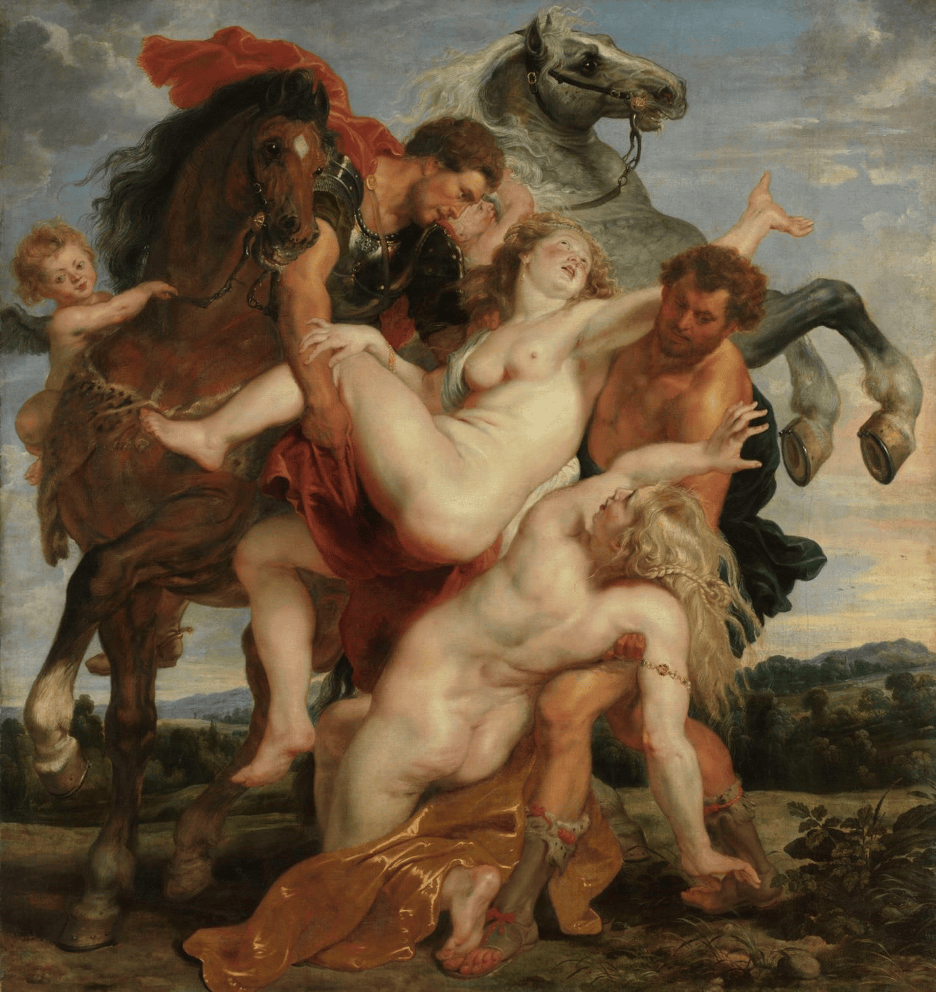
Rape has been a central theme in art history since ancient Greek times. Katie Michael (2017) explains how art depicting rape and war was often the focal point and popular subject in Greek, Roman, and post-renaissance western European art. Asserting that it was such a sought-after theme that the term coined by Susan Brownmiller (1975), “heroic rape”[*2], was applied to these narratives (Michael, 2017; Brownmiller, 1975, pp. 283-308). Diane Wohlfthal (2000) demonstrates that there were two primary ways in which heroic rape images were constructed to appeal to the male gaze. Some artists simply disregarded the standard literary versions of the myth and depicted the rape as if it were a seduction. Correggio´s (1531-31) “Jupiter and Io”, is an example of a painter, in search of an erotic subject, choosing a “heroic” rape myth and subverting its narrative by constructing the victim as a willing lover (Wolfthal, 2000).
Furthermore, Brownmiller (1975) observed that goddesses and mortal women raped by ancient Greek or Roman gods or heroes “rarely suffered serious consequences” in the sense that they are written to i.e. welcome their rapists back or able to bathe in a magic river restoring their virginity yearly (p. 283; Wolfthal, 2000). As Michael (2017) notes, these scenes of rape take on an almost romantic view and covers up the truly heinous crime committed.
The hero(es) perpetrator(s) in the story claim victory over land and in turn violate their adversaries´ women (Michael, 2017). Wolfthal (2000) describes how “heroic” rape imagery aroused not only sexual desire but also feelings of omnipotence; forcing a woman to submit sexually was viewed as parallel to political domination of one’s subjects. Margaret Carroll (in Wolfthal, 2000) show that aristocratic rulers identified with Roman gods and heroes who possessed absolute power and operated above the law. Relying on action, not thoughtful reflection, these classical figures were able to violently subjugate others. Although “heroic” rape imagery at times suggests the destructive results of this subjugation, it nevertheless constructs the hero perpetrator as an admirable figure, virile, strong, and courageous, whose fame and success rests in part on his acts of (sexual) violence (Wolfthal, 2000) against women like we see exemplified in Odins rape of Rind, and Poseidon’s rape of – and Perseus’s beheading of – Medusa.
As such you might not recognize rape being the central theme when viewing art or reading adaptations of these rape myths, unless you (critically) read the story behind them. There are several pieces of art throughout history we could study that focus on themes of sexual violence (even popular children’s stories popularized by Disney). Victim blaming is the central outcome of these stories in Greek, Roman and Norse mythology*[3]. These acts of rape are not seen as unacceptable. In fact, the gods committing sexual violence against women is glorified and seen as their divine right (Michael, 2017). Much like man sees it as his right.
[*2] *2 That´s one heavy read
[3] Not to mention contemporary film and TV, we really haven’t come all that far, have we?
My Poetic Justice for Rind
In Norse Mythology, Odin and his brothers decide to kill the primordial Jotun, his meat turns to land, his blood turns to rivers and oceans, his head to the skies and his brain becomes the clouds. The Gods as such creates the world through a violent patricide, thus begins the feud between the Gods and the powers of chaos (or nature) known as Jotun.
Following the death of his son Balder, Odin (God of war, master of greed and voraciousness) seeks to create an avenger of his blood. Thus, he seeks out and asks for the beautiful Jotun princess, Rind, (goddess of protection for sexual violence victims*4) hand in marriage. After her several rejections he turns to deception and trickery, steals Jotun rune magic to rob her of her sanity (gaslighting hysterical women is rare, right?). Finally, by manipulating her father to help she is bound to her bed. Then, Odin rapes her. Consequently, she gives birth to Våle, who Odin wanted to kill his other son Hod, as he himself could not avenge his own blood by killing another of his blood without facing consequences (obviously). Raping an innocent woman to create a magically strong son and sacrifice him for his own agenda though, that’s okay apparently.
This continued violence towards forces even the Gods can´t control, brings forth their own violent ending, Ragnarok. As such I see the impending doom of the white imperialist militaristic capitalist patriarchy looming. As a woman and an artist, I find power to deliver such poetic justice.
Medusas Curse Power
As Jotun represents the powers of chaos and the natural forces (Æsene) Gods and men could not control. In ancient times, (I´d say it’s still how many feel) as Doris K. Silvermann (2016) resonates, women represented the destructive chaos found in nature compared with the civilized*5 ways of men in Greek society (p. 121).
Like Rind was to Odin, the beautiful gorgon, Medusa, was the Greek God of War, Poseidon’s, favorite. She too rejected him, though he threatened her life and that of a whole village. To keep safe from the possessive Poseidon she swore an eternal vow of chastity to be the priestess in the goddesses Athena´s temple in return of her help. Poseidon still found her and raped her in Parthenon. Consequently, Medusa is no longer seen as a “pure virgin” and as such cannot serve the goddess or legitimately marry. Symbolizing how women are seen as property of men. Athena later banishes Medusa to an isolated island, removes her beauty by turning her hair into snakes and making her facial features so repulsive that no man will ever touch her again, and if they make the mistake of gazing at her they´ll be petrified. Effectively she is isolated, banished, silenced, punished and victim blamed (Katie Michael, 2017; Jessie Burton, 202, pp.
110-130).
Because of the female link with the wildness of nature, Rind and Medusa´s power to create life as well as take it made them akin to the fertility in nature and far beyond the control of men or Gods. However, Medusa is tricked and beheaded by Perseus in all the mythic accounts of her story (s. 121). Freud (1940) wrote of the decapitation of Medusa and commented that “to decapitate = to castrate” (in Silvermann, 2016, p.121).
In a way she survives the decapitation; though she no longer lives she still holds the ability to terrorize and petrify. Perseus keeps her head and uses her to frighten and defeat his enemies with her deadly gaze. Without her powerful visage he is vulnerable and impotent against his foes. She retains her power. She is not vanquished. Her might and potency are not diluted by her mirrored reflection. This recognition suggests that her power harms only men (Silverman, s. 121-122), maybe even only men meaning to do harm. Like the violence done to Rind brings man and Gods own destruction, so too does the violations toward Medusa bring man or Gods destruction. Thus, both become “powerful feminist fantasies of revenge for despoiled sexuality” (Silvermann, 2016, p. 122).
Images hold the power of a thousand words they say. Reflecting reality, but more so they can influence attitudes and affect actual events (I trust we all know how effective the commercial propaganda industry is these days). The blurring of seduction and rape (what we these days call “grey area”) in these paintings was not confined to the domain of culture or art, rather it spilled over into the legal area (Wolfthal, 2000).
[*4] I will use victims because not all survive, and surviving is relative anyway. 5 Debatable, they did write history according to their ego…
[5] Debatable, they did write history according to their ego…
Un-Heroic Rape in Contemporary art
As Wolfthal (2000) states you won´t find many (if any) “heroic” rape images produced by femme artists during the Renaissance or Baroque periods. However, there is a long tradition of poetic justice being served.
Artemisia Gentileschi’s depiction of Susanna and the Elders (1610), in which she sympathizes with the victim*6. The painting shows Susannahs vulnerability and the anguish of sexual violence7 rape. Gentilechini refuses to see Susannah as a seductress or sex object and brings Susanna´s voice to the forefront by inverting the usual reading served by her male counterparts (Wolfthal, 2000).
The artist was dedicated to depicting justice against violent men in the most brutal fashion throughout her career.
[*6] Shocking, I know. One could be radicalized by less, am I right?
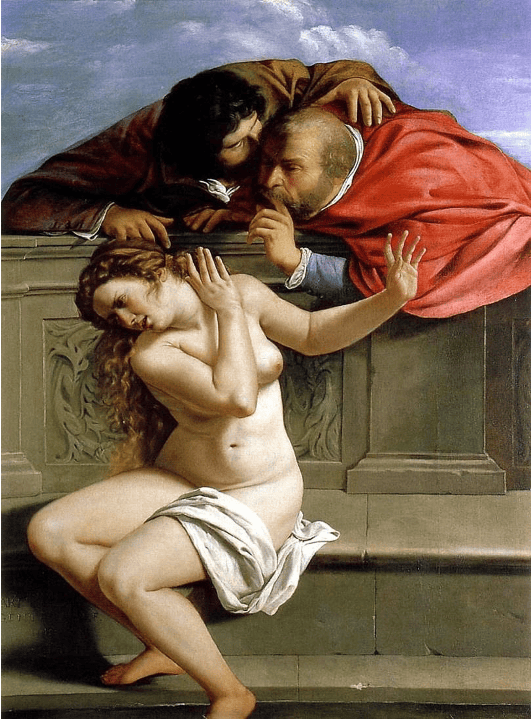
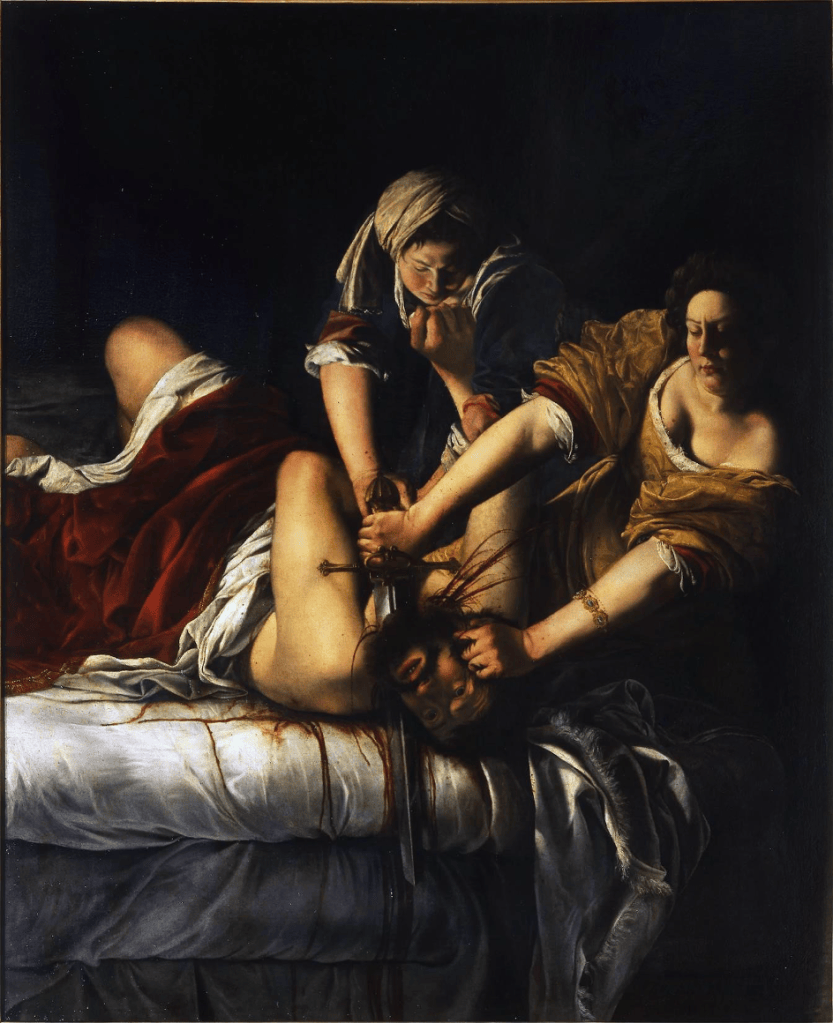
In contemporary art I´d like to mention the exhibition about the iconography of rape: The Un-Heroic Act (2018), curated by Monika Fabijanska. The show aimed to fill the gap in art history where the subject of rape has mainly been depicted as “heroic” by male artists (Anya and Andrew Shiva Gallery, 2018).
The selection of works takes responsibility of showing three generations of female artists, ethnic diversity, all visual mediums, be it drawing or social practices, languages and the various themes that inspired artists to treat the subject (Anya and Andrew Shiva Gallery (2018). Here we will look at two of them which relate to other works of mine; Mapping Fog of War (ongoing, see previous semesters), and the Archive of Hidden Figures (the shelf I have room for every story on).
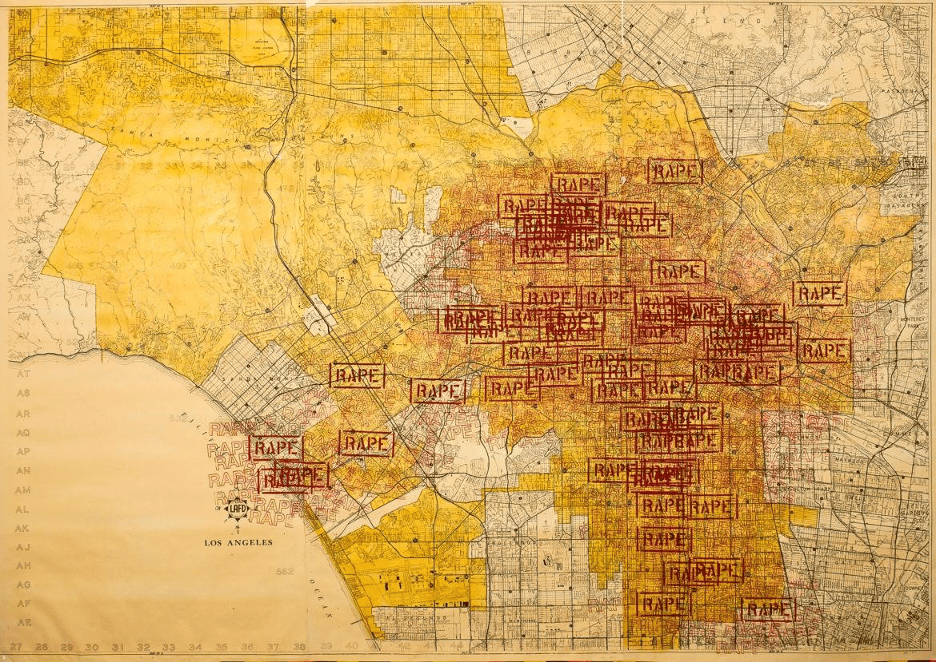
Suzanna Lacys´ Three Weeks in May (1977) exposed the extent of reported rapes in Los Angeles during a three-week performance (Anya and Andrew Shiva Gallery, 2018). Why talk of rape in a gallery, when it could happen to you on your way home?*8
My maps (The Fog of War) is a record of the effect of living on with PTSD, where I´ve dared to walk, or where I´ve stayed imprisoned as I couldn’t dare taking the chance of venturing outside again. Much like Medusas banishment to an island, forced to petrify those getting close to me as my need for assistance in daily life required them looking at my snakes.
[8] A second map was installed next to the first one showing sites of resistance, organizations and self-help activities for injured women (Lacy, S. 2026)

University, Leeds, England, 2019. Photo: Hamish Irvine
Ono´s ARISING: A CALL (2013-t.d.) consists of testimonials by anonymous women from all over the world (Karlyn De Jongh, Sarah Gold & Jon Hendricks, 2014). I´ve seen the Norwegian part in progress when it was shown at The Nobel Peace Center in 2023 through 2024. It also serves as an archive of hidden figures. It contains horrific stories of violence done by men to Norwegian women, but like Pandoras box these records also come with hope. Because as Lorde (2017) puts it: “Here we are attempting to address each other’s eyes directly. Even if our words taste sharp as the edge of a lost woman’s voice, we are speaking” (p. 147). Finally, we are coming together, acknowledging that women are indiscriminately discriminated and raped globally. However, every moment we band together, speak up, we are one step closer to the end of this rampage. As such I feel the need to answer her call by keep inviting victims to join in letting the anger be released by serving poetic justice to their rapists.
“Without community there is no liberation, only the most vulnerable and temporary armistice between an individual and her oppression. But community does not mean the shedding of our differences, nor the pathetic pretense that these differences do not exist” (Lorde, 2017, s. 91

Sources:
Anya and Andrew Shiva Gallery. (2018). The Un-heroic act: Representations of rape in contemporary women´s art in the US. Downloaded 19.05.26 from https://shivagallery.org/featured_item/the-un-heroic-act-representations-of-rape-in-contemporary-womens-art-in-the-u-s/
Brownmiller, s. (1975). Against Our Will – Men, Women and Rape. Penguin Books. http://www.incesttraumacentar.org.rs/biblioteka/7.Klasici/2.Against%20Our%20Will%20-%20Men,%20Women%20and%20Rape,%20Susan%20Brownmiller.pdf
Burton, J. (2021). MEDUSA, The Girl Behind the Myth. Bloomsbury Publishing Plc.
Jongh, K., D., Gold, S. & Hendricks, J. (2014). YOKO ONO, ARISING.https://europeanculturalcentre.eu/var/gallery/file/b6ac0febd2bd75a5cbb813a6f3f684fd.pdf
Lacy, S. (2026). Three Weeks in May. Downloaded 18.05.2026 from https://www.suzannelacy.com/three-weeks-in-may
Lorde, A. (1980). The Transformation of silence into Language and Action. Speech originally delivered at the Lesbian and Literature panel of the Modern Language Association’s December 28, 1977, meeting. Downloaded 20.05.26 from https://interminablerambling.com/wp-content/uploads/2023/12/2a815-thetransformationofsilenceintolanguageandaction_byaudrelorde.pdf
Lorde, A. (2017). Your Silence Will Not Protect You. Silver Press.
Michael, K. (2017). Examining Rape in Art History. Avalon. Downloaded 17.05.26 from https://avalonhealing.org/rape-in-art-history/
Silverman, D., K. (2016). Medusa: Sexuality, Power, Mastery, and Some Psychoanalytic Observations. Studies in Gender and Sexuality, 17:2, 114-125, DOI:10.1080/15240657.2016.1172926
Wolfthal, D. (2000). Excerpts from Diane Wolfthal, Images of Rape: The “Heroic” Tradition and its Alternatives.Downloaded 19.05.26 from http://employees.oneonta.edu/farberas/arth/arth200/Heroic_Rape.html
Referenced art:
Correggio. (1531-31). Jupiter and Io, Oil on canvas. Kunsthistoriche Museum, Vienna. https://www.wga.hu/html_m/c/correggi/mytholog/io.html
Gentileschi, A. (1610). Susanna and the elders Oil on canvas. Schloss Weißenstein, Pommersfelden. https://www.arthistoryproject.com/artists/artemisia–gentileschi/susannaand–the–elders/
Gentileschi, A. (1614-20)). Judith beheading Holofernes Oil on canvas. Uffizi Gallery, Florence. https://www.arthistoryproject.com/artists/artemisia–gentileschi/susanna–andthe–elders/
Giambologna. (1583). The Rape of the Sabine Woman Marble Sculpture. Loggia dei Lanzi, Florence. https://www.galleriaaccademiafirenze.it/en/artworks/ratto–delle–sabinegiambologna/
Lacy, S. (1977). Three Weeks in May Ink on paper. Hammer Museum, Los Angeles.
https://shivagallery.org/featured_item/the-un-heroic-act-representations-of-rape-incontemporary-womens-art-in-the-u-s
Ono, Y. (2013/2019). ARISING Participatory installation. Ongoing travelling globally, photo was found from the documentation of when it was at: Blenheim Walk Gallery, Leeds. https://corridor8.co.uk/article/yoko-ono-at-leeds/
Poussin, N. (1634-38). The Abduction of the Sabine Women Oil on canvas. The Metropolitan Museum of Art, New York.
https://www.metmuseum.org/art/collection/search/437329
Rubens, P., P. (1616-18). The Abduction of the Daughters of Leucippus. Oil on canvas. Alte Pinakothek, Munich. https://www.wikiart.org/en/peter–paul–rubens/rape–of–thedaughters–of–leucippus–1618
Sarton, M. (1971). Medusa the Muse. Poem.https://www.danielharper.org/yauu/2015/01/medusa/
Tritian. (1559-1562). The Rape of Europa Oil on canvas. Isabella Stewrt Gardner Museum, Boston. https://www.gardnermuseum.org/experience/collection/10978


Leave a Reply